
The thirty-fifth edition of the Karpacz Economic Forum closed on 10 September in Lower Silesia: three days — from 8 to 10 September — of economic, institutional and geopolitical debate, and one of the leading appointments in Central and Eastern Europe. Confindustria Polonia took part as an official Partner, bringing to the centre of the discussion the economic relations between Italy and Poland and the opportunities that arise when regions, companies and institutions build stable connections.
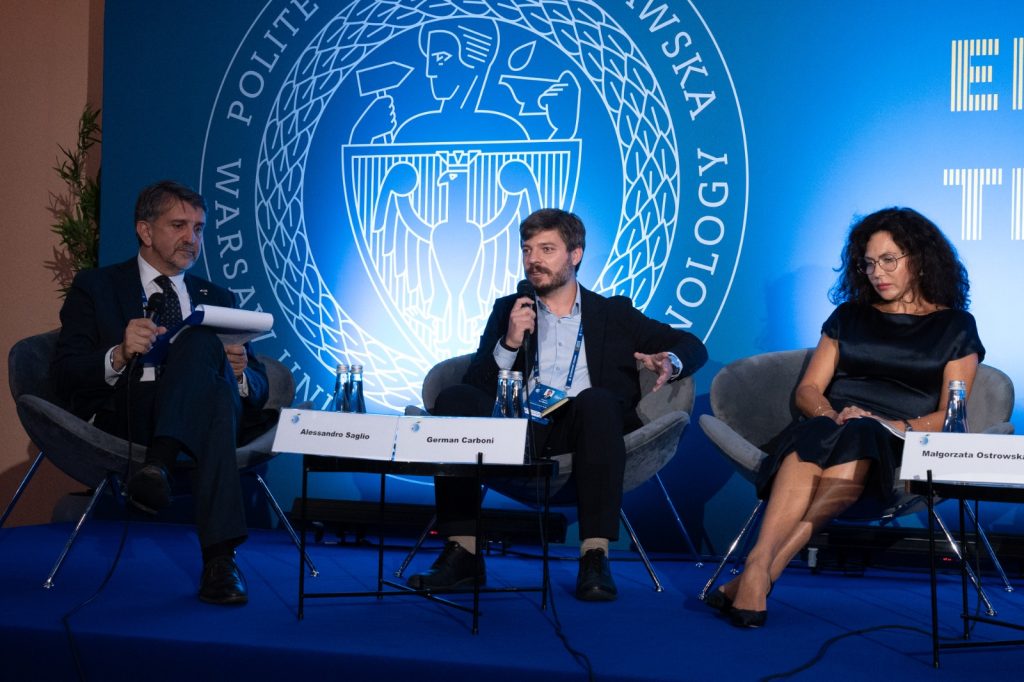
The central moment was the panel «Connecting Territories. Creating Opportunities: How Air Connectivity Can Build Long-Term European Partnerships», devoted to the relationship between connectivity, internationalisation and regional development. The starting point was a concrete fact: the opening of five new direct air links between Turin and Poland. A direct flight, however, is not merely mobility: it makes business meetings, investment, trade and mutual knowledge of the two territories possible — but on its own it produces nothing. What turns a route into an opportunity is what gets built afterwards.
The discussion was moderated by Alessandro Saglio, Founder & Project Director of the Piemonte–Poland Strategic Partnership and Vice-President for Institutional Affairs of Confindustria Polonia. With him were German Carboni, Head of the Economic Office at the Italian Embassy in Warsaw, on the role of economic diplomacy in consolidating bilateral relations; Michał Rado, Deputy Marshal of Lower Silesia, who presented the region as a platform for synergies with the Italian economic system; Karol Przywara, Chairman of the Board of Wrocław Airport, for whom an airport is a development platform before it is a transport infrastructure; Małgorzata Ostrowska, Vice-President of the Polish-Italian Business Council, with the message «People first. Business second»; and Patrizia Paglia, Automotive Industry Delegate of Confindustria Piemonte, on the reasons that lead the Piedmontese industrial system to look to Poland as both a market and an industrial ecosystem.
One indication emerged from the discussion that holds well beyond the Piedmontese case: continuity. The dialogue opened at Karpacz will continue in the coming weeks with the institutional mission of Lower Silesia to Piedmont, involving institutions and companies from both territories. That is the point at which one sees whether a connection becomes a collaboration.